Whose Smile Are We Trying to Perfect?
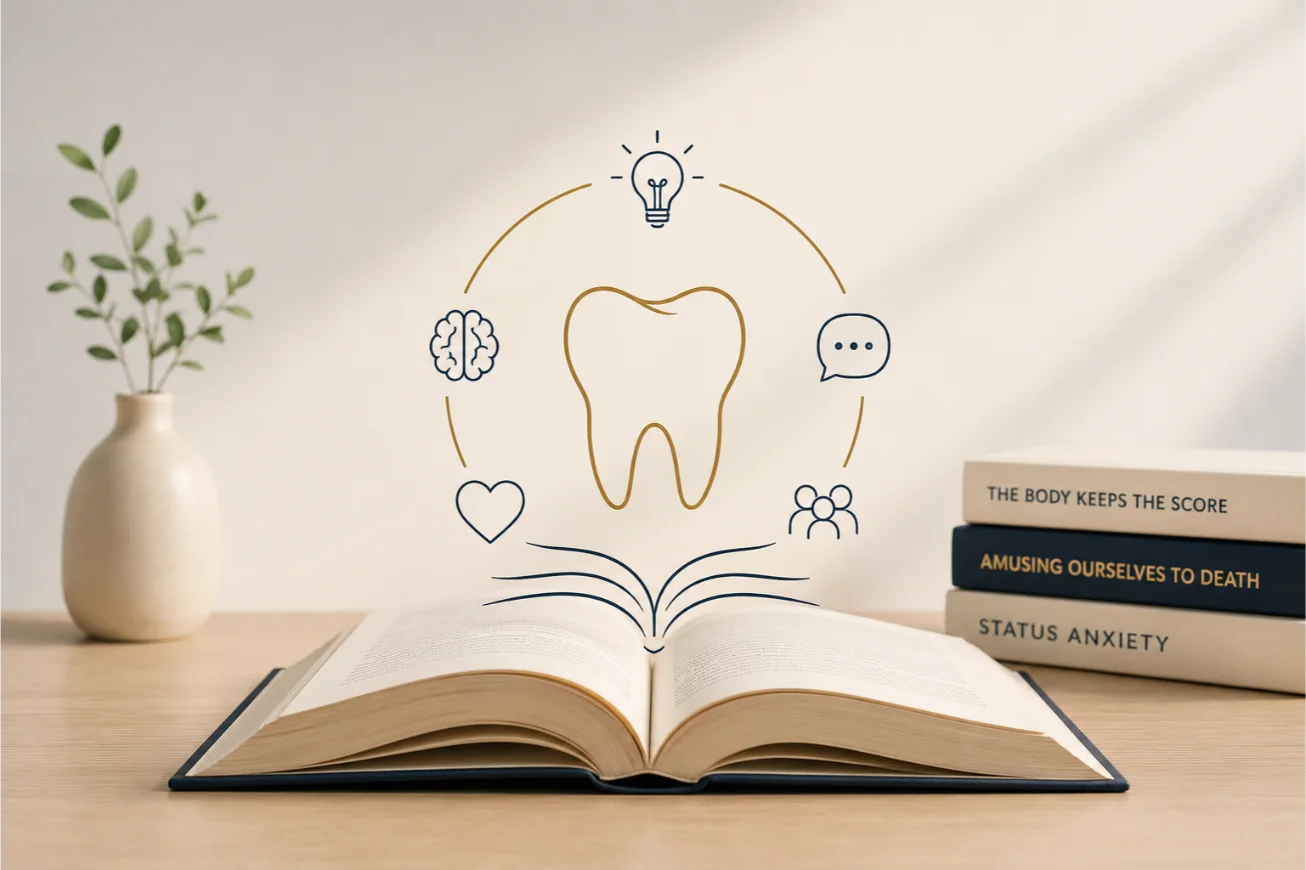
What The Courage to Be Disliked made me think about cosmetic dentistry, comparison, approval and the idea of a perfect smile.
Ichiro Kishimi & Fumitake Koga
The Courage to Be Disliked is built around the ideas of psychologist Alfred Adler.
Despite its title, the book isn't really teaching us how to make people dislike us.
Its argument is much more interesting.
Much of our unhappiness, the book suggests, comes from the way we experience ourselves in relation to other people.
We compare.
We want recognition.
We worry about how we are seen.
And sometimes, without noticing it, we begin living according to expectations that may not really be our own.
The book asks a difficult question:
How much of the life we are trying to build is genuinely ours, and how much of it is shaped by our desire to be accepted by other people?
While reading it, I kept thinking about something I hear regularly in dentistry.
"I don't like my smile."
"I Don't Like My Smile."
It sounds like a very simple sentence.
Someone doesn't like something about their teeth and wants to change it.
And sometimes it really is that simple.
A tooth may have bothered someone for years.
Perhaps they have always avoided smiling in photographs.
Perhaps they dislike the shape, position or colour of their teeth.
Modern dentistry can often help.
But after reading this book, I started wondering whether another question sometimes sits underneath that sentence.
"I don't like my smile - compared with what?"
Compared with the smile I used to have?
Compared with my friends?
Compared with someone on Instagram?
Compared with the people I work with?
Compared with an edited photograph?
Compared with what I imagine other people notice when they look at me?
Or is there genuinely something about my smile that has bothered me for a long time?
Those questions may sound similar.
I don't think they are.
When "Better" Quietly Becomes "Perfect"
Human beings have always compared themselves with other people.
Social media didn't invent comparison.
But it may have industrialised it.
We can now compare ourselves with hundreds of people before breakfast.
Their homes.
Their holidays.
Their bodies.
Their careers.
And, of course, their smiles.
The problem is that we are often comparing ordinary life with something carefully selected.
The best photograph.
The best angle.
The best lighting.
Sometimes filters.
Sometimes professional photography.
Sometimes dentistry itself.
After enough exposure, something unusual can happen.
Normal can begin to look abnormal simply because perfect has become familiar.
Natural teeth have variation.
They have texture.
They are not always perfectly symmetrical.
Their edges aren't always identical.
And natural tooth colour exists across a range.
Yet when we repeatedly see one particular version of a "beautiful smile", our reference point can slowly move.
The teeth haven't necessarily changed.
The standard against which we judge them has.
Who Are We Hoping Will Notice?
One theme running through The Courage to Be Disliked is our desire for recognition.
We want to be seen positively.
We want approval.
We want to know that other people value us.
There is nothing strange about that.
We are social beings.
But it made me think about a question that rarely appears on a dental treatment plan:
If nobody else could see the result, would I still want this treatment?
I think that is an interesting question.
Not because there is a correct answer.
And certainly not because wanting other people to find us attractive is somehow wrong.
But because the answer may tell us something about what we are actually hoping treatment will achieve.
Are we changing a tooth?
Are we trying to feel more confident?
Are we hoping other people will see us differently?
Or are we hoping that changing something on the outside will change something more complicated on the inside?
Dentistry can do many things.
It is important to understand which of those things it can realistically promise.
This Is Not an Argument Against Cosmetic Dentistry
I want to be clear about something.
I don't think wanting to improve your smile is superficial.
I have seen how changing something that has bothered a person for years can affect the way they smile, speak and carry themselves.
Cosmetic dentistry can be genuinely meaningful.
But perhaps good cosmetic dentistry requires more than technical skill.
It also requires curiosity.
Not only:
"What would you like me to change?"
But sometimes:
"What are you hoping will feel different once we change it?"
That question matters because the same treatment can mean very different things to different people.
One person may want to repair a chipped front tooth.
Another may have disliked a particular tooth since childhood.
Another may want their teeth to look exactly like an image they have seen online.
Another may believe that a perfect smile will finally make them confident.
Technically, all four conversations may end with dentistry.
But they don't necessarily begin in the same place.
Can Dentistry Give Someone Confidence?
We use the word confidence a lot in dentistry.
"Smile with confidence."
"Get your confidence back."
"Transform your smile and your confidence."
Sometimes this is absolutely true.
If someone has spent years covering their mouth when they laugh, improving the thing that bothers them may be enormously freeing.
But confidence is also a much bigger thing than teeth.
A dentist can change the shape of a tooth.
We can change colour.
We can change alignment.
We can replace missing teeth.
What we cannot guarantee is how someone will feel about themselves afterwards.
Dentistry can change a smile. It cannot promise to change the relationship someone has with themselves.
I think that distinction matters.
Especially in an age where the language of healthcare and the language of transformation can easily become mixed together.
What Does a Perfect Smile Actually Look Like?
This sounds like a technical dental question.
It isn't entirely.
Dentistry has principles of proportion, symmetry, tooth position, colour and smile design.
Those principles are useful.
But faces are not identical.
Personalities are not identical.
Ages are not identical.
And perhaps smiles shouldn't be identical either.
There is a difference between improving something and removing every sign that it was ever natural.
There is also a difference between symmetry and beauty.
Some of the most memorable smiles aren't mathematically perfect.
They simply belong naturally to the person wearing them.
If every smile is designed towards the same idea of perfection, at what point do we stop improving individuality and start removing it?
Sometimes the Hardest Dentistry Is Knowing When to Stop
Modern dentistry gives us extraordinary abilities.
We can move teeth.
Whiten them.
Bond them.
Veneer them.
Crown them.
Replace them.
Digitally design them before treatment even begins.
The question is no longer simply:
"Can we change this?"
Increasingly, the answer is yes.
The more difficult question is:
Just because we can improve something, how do we decide when it has been improved enough?
That question becomes particularly important when healthy tooth structure is involved.
Teeth are biological.
Every intervention has consequences.
Restorations require maintenance.
Materials age.
Teeth age.
People age.
A treatment decision made at 25 may still have consequences at 45, 65 and 75.
That doesn't mean we shouldn't treat.
It means the reason for treatment matters.
Whose Task Is It?
One of the most interesting ideas in the book is what Adlerian psychology calls the separation of tasks.
Put simply, we cannot completely control what other people think about us.
Their judgement belongs to them.
Our choices belong to us.
That sounds simple.
In real life, it is incredibly difficult.
And it made me think about appearance.
We can spend enormous energy trying to control how other people see us.
Clothes.
Cars.
Houses.
Careers.
Bodies.
Teeth.
But there is no treatment that can guarantee another person's approval.
Perhaps that is worth remembering before asking dentistry to solve a problem that actually belongs somewhere else.
Are we changing the smile because we want to, or because we are trying to control how somebody else sees us?
So What Should Good Cosmetic Dentistry Protect?
I don't think the answer is to reject cosmetic treatment.
I think the answer is to become more thoughtful about it.
Perhaps the best cosmetic dentistry isn't the treatment that attracts the most attention.
Perhaps it is the treatment that eventually allows the patient to stop paying so much attention to their teeth.
Maybe the Goal Isn't the Perfect Smile
The title The Courage to Be Disliked is deliberately provocative.
But the idea I took from it is not that we should stop caring about other people.
It is that there is a cost to building our sense of ourselves entirely around their approval.
That seems particularly relevant in a world where comparison follows us everywhere.
Including into the dental chair.
There is nothing wrong with wanting straighter teeth.
Or whiter teeth.
Or replacing something that has bothered you for years.
But perhaps before changing something healthy and irreversible, there is value in understanding where the desire for change came from.
Do I want a different smile because it would genuinely matter to me, or because somewhere along the way I learned that the smile I already have isn't good enough?
I don't think dentistry can answer that question for someone.
But perhaps good dentistry should leave enough room for the patient to ask it.
What stayed with me after reading The Courage to Be Disliked wasn't really the idea of being disliked.
It was the idea of how easily we can start seeing ourselves through other people's eyes.
And I think dentistry sometimes sits right in the middle of that.
Someone can genuinely want to change their smile.
There is nothing wrong with that.
But there is a difference between helping someone change something that has bothered them for years and chasing a standard of perfection that keeps moving every time we open our phone.
The older I get, and the longer I practise dentistry, the more I think restraint is part of good treatment.
Not every imperfection needs correcting.
Not every healthy tooth needs improving.
And not every beautiful smile needs to look like somebody else's.
Maybe the goal of cosmetic dentistry shouldn't be to give everyone a perfect smile. Maybe it should be to help people reach a point where they can stop thinking about their smile and get back to living their life.